Fire Sale: Russia’s Retreat and a New Energy Order
Recent Articles
Author: Dr. Eric Rudenshiold
04/16/2026
The forced unwinding of Russia’s overseas energy empire is a massive secret hiding in plain sight that masks one of the most consequential shifts in the post-Soviet economic space since the 1990s. Russia stands to lose significant portions of its traditional energy economy, with implications that foretell change across all energy markets in Eurasia.
U.S. Treasury Office of Foreign Assets Control (OFAC) 2022 sanctions were imposed to restrict Russian oil sales and reduce Moscow’s ability to sustain its war in Ukraine. Combined with 2025 trade restrictions, price caps, and asset freezes, these measures have compelled Russian firms including Lukoil, Gazprom, and Rosneft to either divest, restructure, or abandon major portions of their international portfolios. The result is the effective blacklisting of targeted Russian energy firms and their exclusion from the U.S. banking system and large portions of the global economy.
These are not isolated financial adjustments but harbingers of a deeper reconfiguration of Russia’s economic model. Pre-sanctions oil and gas sector revenues contributed up to 30-50% of the Russian federal budget, but have since declined to only 25% under sanctions. While Russia’s war economy remains adaptive, it is still dependent on hydrocarbon exports. Across the Caspian and Central Asia, this decline is driving a consequential realignment of partnerships and strategic thinking regarding the slow denouement of Russia’s dominant role over post-Soviet energy flows.
For decades, Russian companies operated not only as producers but as gatekeepers and intermediary negotiators for the former-Soviet sphere and patron states. Today, that centralized system is fracturing under the combined pressures of sanctions and war.
Moscow’s Forced Retreat
The original U.S. sanctions targeting Russian hydrocarbons intended to limit Russian revenues fueling the war in Ukraine while avoiding a global energy crisis. Current sanctions, however, are more systemic impediments to the Kremlin’s energy industry and its overall economy, limiting Russian firms from operating internationally. Companies like Lukoil have as a result been obligated to exit foreign markets and liquidate their international assets.
For Lukoil, historically one of Russia’s most globally integrated energy firms, this represents a profound loss. Its overseas portfolio that once spanned over 30 countries across Europe, the Middle East, and parts of Africa is in the process of disintegrating. The company’s divestments are not voluntary commercial choices but driven primarily by sanctions restricting dollar transactions, insurance access, and technology transfers, making continued operations unsustainable.
Gazprom’s trajectory reflects a similarly severe revenue decline, as its stable income stream relied upon a Eurocentric pipeline network. The collapse of its primary export market in the wake of Ukraine sanctions compelled the company to drastically scale back or simply write off international engagement ambitions.
Rosneft, Moscow’s largest oil producer, once anchored the country’s petroleum economy, but has suffered an over 70% sanctions-fueled decline in net income. International restrictions have forced the Russian mega-concern into diversifying its operating base away from lucrative Western markets to less profitable and more distant bargain-seeking regions. Across all three firms, reduced profitability, higher operating costs, and constrained access to Western capital has fundamentally reshaped and reduced global prospects.
War and Pieces: Damage and Decline
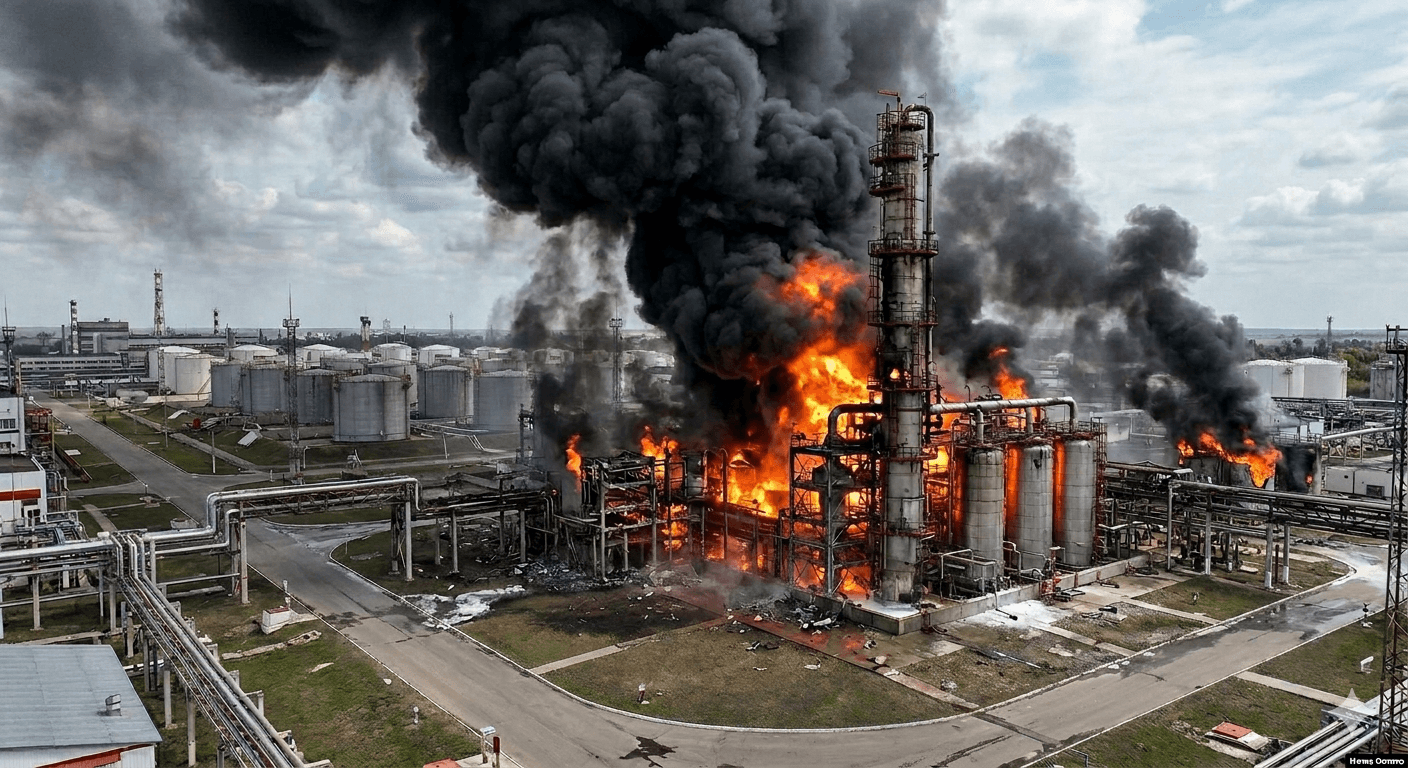
Compounding these structural pressures is the physical damage inflicted on Russia’s energy infrastructure by Ukrainian operations. Over the course of the war, Ukraine’s “kinetic sanctions” have targeted refineries, storage facilities, and logistical nodes deep inside Russian territory, disrupting output and destabilizing Moscow’s entire energy industry.
The impact is cumulative, as Kyiv is targeting Russia’s entire petro-value chain. With reduced exportable volumes, damage to storage and transport infrastructure, the need for constant repair diverts capital and technical resources. In effect, Russia’s energy sector is being degraded both financially and physically. Paper sanctions constrain its ability to operate abroad and kinetic pressure undermines domestic capacity.
Similarly, the war in Iran limits Tehran’s viability to offer a potential alternative corridor to the Persian Gulf and the Global South for energy exports. Neither a viable alternative for Moscow nor the states of Central Asia and the South Caucasus, Iran faces sanctions, financial isolation, infrastructure challenges, and security constraints that effectively preclude its capacity to function as a reliable energy transit route. The lack of a southern option places greater emphasis on East-West connectivity for Eurasian states diversifying away from Russian control.
Disaggregation and Demise
Russia’s post-Soviet energy system functioned as a centralized network linking Central Asia and the South Caucasus to global markets through Russian-controlled legacy infrastructure. This system enabled Moscow to exert significant influence over transit routes, pricing, and investment patterns across the region.
Over decades, Lukoil and Gazprom served as pillars of Russian foreign policy, reinforcing Moscow’s role as overseer of Eurasian energy flows. Considered as its back yard, the South Caucasus and Central Asia received particular attention from Moscow to projects involving Western companies. But Europe’s decision to phase out Russian gas imports has removed the largest and most lucrative market for Gazprom and weakened its stewardship role, by opened the door for new gas and oil producers. The forced withdrawal of Russian firms from international markets have weakened this entire system.
As Russian transit dominance erodes, Central Asian producers are accelerating efforts to diversify export routes, increasingly bypassing Russian infrastructure altogether. This reflects a long-standing diversification strategy that is now becoming operationally feasible, fundamentally weakening Moscow’s leverage over regional energy systems, as alternatives reshape the region’s orientation and erode the structural foundations of Russian influence.
Azerbaijan and Kazakhstan: New Players Arise
One of the primary beneficiaries of this shift is Azerbaijan’s State Oil Company (SOCAR), which operates as a key transit hub through the Southern Gas Corridor and the Baku-Tbilisi-Ceyhan pipeline. Azerbaijan already offsets Russian supply disruptions to Europe, providing oil to more than a dozen countries in Europe, the Middle East, and Asia. SOCAR is steadily expanding its footprint to become a producer as well.
Facing the prospect of declining domestic output, SOCAR began diversifying into multiple revenue streams including exploration, global partnerships, investing in renewable energy and decarbonization, and moving into European refining. Lukoil and Gazprom’s retreat is fueling SOCAR and its partners’ move to occupy roles previously dominated by Russian firms. Baku is not just seeking to fill the space left by Moscow’s retreat, but actively repositioning itself to supplant Russia as a central node of energy production, transit, and influence.
Kazakhstan, heavily dependent on Russian transit infrastructure through the Caspian Pipeline Consortium (CPC), is similarly diversifying. The CPC is the country’s primary export artery, carrying 80% of the country’s crude exports by crossing Russian soil, being overseen by Russian workers and governed by Russian law. Multiple recent disruptions have underscored the risks of dependence and prompted Astana to seek alternatives. As a partial hedge, Astana is increasing tanker shipments across the Caspian to Azerbaijan, feeding modest amounts into the Baku-Tbilisi-Ceyhan pipeline which was originally envisaged to carry Central Asian energy.
Additionally, Kazakhstan is actively seeking new investment partners, as the reliability of Russian companies and transit have come into question. The virtual exit of Russian capital is further accelerating this diversification process, including efforts by Astana to buy out Lukoil’s significant shares in Astana’s key energy concerns.
The Caspian Rubicon
Perhaps the most telling indicator of change is the renewed interest in Trans-Caspian pipelines, long stalled by Moscow and Tehran. High-level discussions between Turkmenistan and Azerbaijan, including agreements to jointly develop offshore fields, have revived the prospect of linking Turkmen gas to the Southern Gas Corridor. Reflecting a weakening of Russian and Iranian restraints, such connectivity would allow Turkmenistan, home to some of the world’s largest gas reserves, direct access to European markets.
Recent gas finds in Kazakhstan and Uzbekistan, along with development agreements that exclude Russian participation, add further momentum to the reconfiguration of regional gas flows. Similarly, Kazakhstan and Azerbaijan have expanded cooperation on trans-Caspian oil transit, as Astana seeks to reduce reliance on the CPC pipeline.
In parallel, discussions have begun again around a potential dedicated sub-sea, trans-Caspian oil pipeline as an alternative to the Russia-linked CPC. These initiatives reflect a strategic convergence between Kazakhstan and Azerbaijan to enhance export flexibility by creating a westward oil corridor. Alongside interests in Turkmenistan and Uzbekistan, a convergence of pipeline thinking indicates bridging the Caspian may be less a question of “if” versus “when.”
Decline and Rise
Taken together, these developments indicate a fundamental shift in Eurasia’s energy alignment. Once cemented by Russian-controlled infrastructure, vertically integrated supply chains, and limited partner diversity, the region’s legacy system is giving way. Central Asian and South Caucasus states are actively cooperating to diversify export routes by expanding trans-Caspian shipping, westward pipeline connectivity, and multimodal transport corridors that bypass Russian influence.
This emerging system is not defined by a new hegemon replacing Russian dominance, but by the fragmentation and disassembly of Moscow’s influence. The forced sale of Lukoil, Gazprom, and Rosneft eliminates key tools used by the Kremlin to wield leverage across Eurasia and other markets. Decisions are now being driven by bilateral agreements, commercial logic, and infrastructure diversification that support economic sovereignty at the national and regional level.
This is not a cyclical downturn but a structural reconfiguration of Russia’s energy sector. The loss of European markets, divestment of international assets, and restricted access to Western finance and technology are driving a long-term decline in revenue. Reciprocally, Russia’s influence over trans-Caspian energy routes is eroding which in turn is impinging its ability to shape regional energy flows and geopolitics.
War Aftermath
Energy has long served as both an economic engine and a foreign policy instrument for Moscow. Its relative decline, therefore, carries implications beyond the loss of revenue, signaling a broader contraction in Russia’s capacity to influence the strategic trajectory of Eurasia. Though current events are often assessed through a conflict lens focused on sanctions, strikes, and strategic competition, the deeper significance for Russia lies in the acceleration of structural change.
The forced sale of Russian energy assets, the physical damage to Russian infrastructure, and market shifts are not isolated issues but components of a broader transformation and gradual dismantling of the system that once defined Eurasian energy. Rising in its place is a more diversified network of routes, investments, and alignments, managed by Eurasian states exercising new-found agency.
This transition is occurring quietly and gradually, as legacy infrastructure, contractual obligations, and political ambiguities continue to wind down but still shape increasingly uncertain outcomes. The direction of change, however, is clear. What is unfolding is not just a response to war, but the beginning of a new energy landscape that will endure long after current conflicts end.