From Trade Routes to Tech Hubs: The Caspian’s Economic Transformation – 2025 in Review
Recent Articles
Author: Lilly Horrigan
12/24/2025
 president.uz
Over the past year, the Caspian region has experienced robust economic momentum, driven by unprecedented foreign investment and a surge of high-profile agreements announced around the C5+1 Summit in Washington. These deals reflect both growing U.S. engagement and the region’s efforts to position itself as a strategic crossroads for energy, trade, and emerging technologies.
During the summit, Kazakhstan signed a $4.2 billion locomotive deal with U.S. company Wabtec and secured a $1.6 billion U.S. EXIM Bank-backed financing agreement with Citibank to support Wabtec’s modernization project. Kazakhstan also confirmed the purchase of 15 Boeing 787 Dreamliners and penned a $2.5 billion deal with John Deere to strengthen Kazakhstan’s agricultural sector. Uzbekistan continued the trend with its own slate of major deals, including energy-related deals worth $4 billion collectively on top of an order for 22 Boeing 787 Dreamliners, further signaling the region’s attractiveness for U.S. companies seeking new markets.
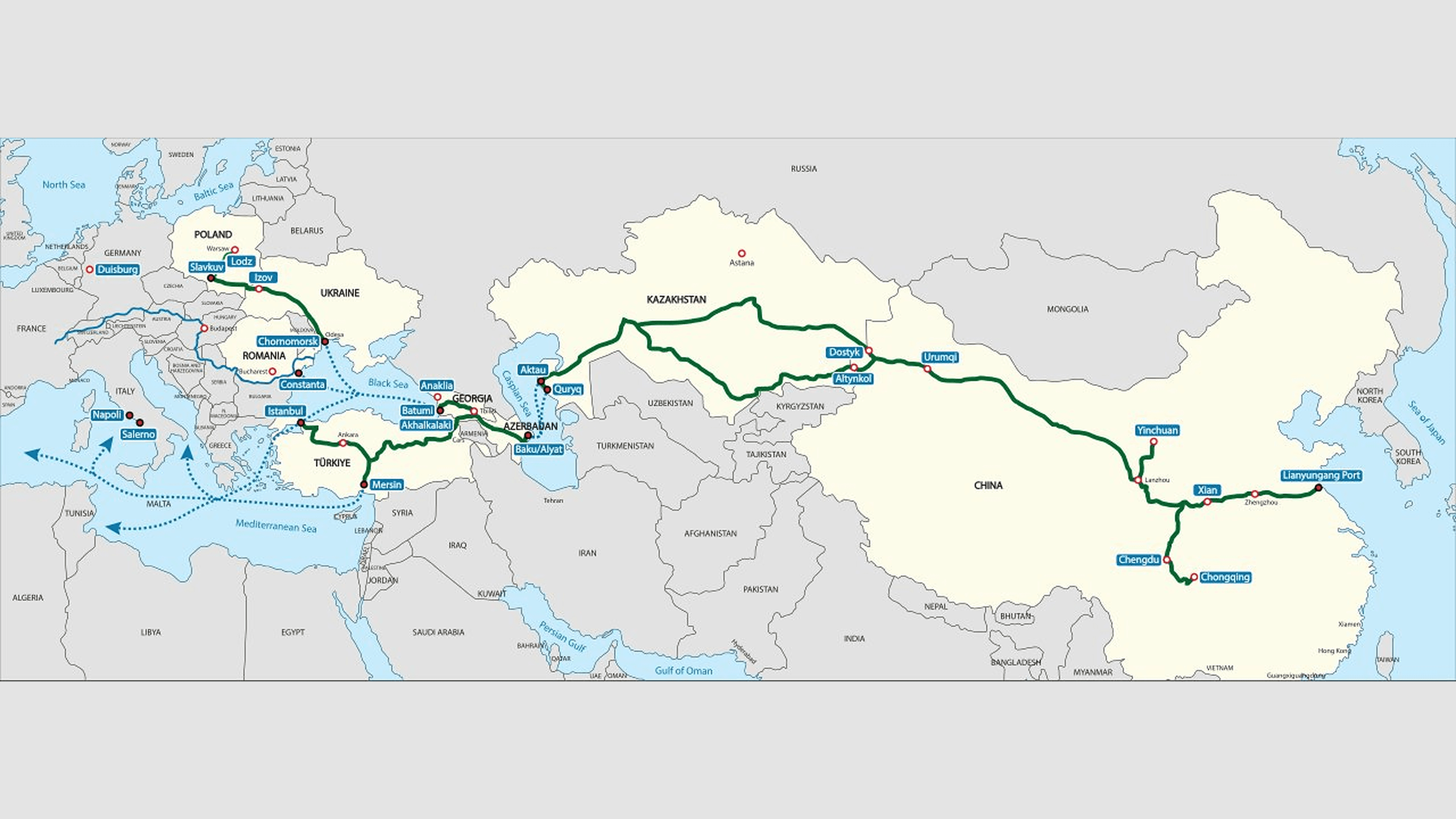
Increased U.S. interest in the region also helped negotiate the historic peace agreement between Azerbaijan and Armenia, a breakthrough that opens new trade opportunities and reduces long-standing regional risk once it is officially signed and ratified. The deal promises to strengthen the Middle Corridor with a route that U.S. President Donald Trump has rebranded as the Trump Route for International Peace and Prosperity (TRIPP). As the war in Ukraine disrupts traditional supply chains, TRIPP offers a viable supplement to the Middle Corridor and more capacity for freight traveling between China and Türkiye. The U.S. government pledged $145 million toward the corridor in September and is expected to expand infrastructure support as implementation advances.
While these investments represent a significant milestone, they are unfolding alongside another transformation: digitization. Artificial intelligence (AI) and national digital currencies have become central to long-term economic strategies across Central Asia and the South Caucasus, positioning the region as an emerging laboratory for digital development.
AI Takes Center Stage
The AI industry has made waves in economies across the globe, and the Caspian region is no exception. Kazakhstan has arguably led the charge after President Kassym-Jomart Tokayev announced the creation of a new Ministry of Artificial Intelligence to oversee the integration of AI into the national economy and develop a unified AI national strategy. Kazakhstan also launched Central Asia’s first supercomputer, Alem.cloud. Its capacity to run advanced simulations and train large language models (LLMs) underpins Kazakhstan’s ambition to build sovereign digital infrastructure. This includes supporting the Kazakh-language Kaz-LLM, developed by Nazarbayev University, which reduces reliance on foreign data centers and provides a more culturally aware user experience.
Systems like Alem.cloud and Kaz-LLM will support further integration of AI into public services. Already the government has implemented AI tools in education and healthcare, ranking 24th out of 193 countries in the 2024 UN global E-Government Development Index with reports that 92 percent of government services are digitized.
The country’s ambitions and success have attracted outside interest. Kazakhstan secured a Memorandum of Understanding valued at up to $2 billion with NVIDIA during the president’s Washington visit. The initiative will partner with OpenAI to provide Kazakhstan with advanced chips and computing systems to power Kazakhstan’s national data centers.
Kazakhstan, however, is not the only country investing in a digital future. Tajikistan became the first in Central Asia to deploy a national AI strategy, develop a hydropower-powered data center, and launch an AI cluster and “Area AI” technopark in partnership with local firm darya.ai. Tajikistan’s leaders frame AI as an opportunity to leapfrog traditional stages of development, aiming to generate five percent of the country’s GDP through AI employment by 2040.
Uzbekistan, too, has made major investments in AI, most notably in the IT Park digital hub. The project offers tax incentives and a streamlined visa process to create an attractive and reliable environment for foreign investors, global talent, and startups. This investment will support domestic innovation and the integration of AI across government and public services to reduce bureaucracy. Uzbekistan’s Digital Technologies Minister Sherzod Shermatov held discussions with NVIDIA on the potential development of an AI Excellence Center focused on providing AI training to educators and specialists.
In March, President of Azerbaijan Ilham Aliyev signed a decree approving the "Artificial Intelligence Strategy of the Republic of Azerbaijan for 2025–2028," aimed at strengthening economic competitiveness, fostering AI innovation, developing a skilled workforce, and expanding public awareness of AI technologies. The Memorandum of Understanding (MoU) on developing a charter on strategic partnership, signed between the United States and Azerbaijan in August, outlines AI and digital infrastructure investment as two of the key areas of focus.
NVIDIA, the world's largest AI chip manufacturer, has also taken interest across the Caspian in Armenia. The company announced that it would launch a $500 million AI chips factory next year in collaboration with the Armenian government.
Digital Currency: A New Frontier
The region’s digital transformation extends beyond AI. Several countries are pioneering digital currencies to increase transparency, expand financial inclusion, and strengthen resilience to geopolitical shocks.
Kazakhstan launched the digital tenge, a third form of currency that is distinct from cash and existing electronic payments. The digital currency allows for greater transparency in government spending, enhanced security, and entirely offline transactions. The project will be especially impactful in remote areas with less reliable access to the internet and major banking systems. President Tokayev has also moved to bring stability to the crypto sector by shifting oversight of digital assets to the central bank’s investment division rather than private actors.
Meanwhile, Kyrgyzstan launched Central Asia’s first gold-backed stablecoin, USDKG. The stablecoin is pegged 1:1 with the U.S. dollar and launched with an initial issue of $50 million. Its structure is semi-decentralized since issuance is linked to the Kyrgyz government, but operational control and gold management are delegated to a private company. This hybrid model ensures stability yet uses cryptocurrency’s flexibility to reduce transaction costs, which is an especially strategic move in a region heavily dependent on remittances.
Turkmenistan has also taken interest in the benefits of cryptocurrency, passing a law legalizing and regulating digital assets. The government hopes that this move will help attract investment and support digitization.
These innovations coincide with mounting pressure on Central Asian labor migrants in Russia. In 2024, remittances accounted for 48 percent of Tajikistan’s GDP, 24 percent in Kyrgyzstan, and 14 percent in Uzbekistan. Yet Russia has tightened restrictions on migrant life and, in some cases, limited transfers to 30,000 rubles per month, effectively blocking remittances. Cheaper, decentralized cross-border payment systems could significantly mitigate these pressures by giving migrants more reliable and efficient channels to support families back home.
Regional Cooperation as Key
Digital currencies could offer Central Asia a degree of insulation from Russia’s anti-immigrant regime, but to reap the greatest benefits from this technology, the region must work together. A coordinated payment system could emulate Europe’s Single Euro Payments Area (SEPA), which reduces cross-border transaction fees, streamlining payments.
However, such cooperation faces major obstacles. No country currently possesses the institutional capacity to manage, let alone secure, a regional digital payment infrastructure. Central banks may also be reluctant to cede authority to supranational structures, given the region’s limited history of formalized monetary cooperation.
Nonetheless, the incentives for collaboration are growing as the benefits become clearer. The costs of building advanced digital infrastructure, like AI hardware, data centers, cybersecurity frameworks, and technical training, are high, and pooling resources could accelerate development while reducing vulnerabilities. The Caspian region’s early investments in AI and digital currencies give it a rare opportunity to capitalize on these aligned strategic goals. With regional cooperation, innovation in digital currency could attract even more foreign investment into the region and streamline regional trade. Moreover, AI is projected to transform the global economy, and by moving quickly and collaboratively, these states could disproportionately benefit from potentially unprecedented economic growth.