Measuring and reflecting on Air Quality in Central Asia
Recent Articles
Author: Zhanel Sabirova
04/14/2026
 shutterstock.com
Across Central Asia, air quality in both cities and rural regions is shaped by local emissions, particularly from fossil fuels used in heating and transportation, as well as from cross-border pollution driven in large measure by the growing frequency of sand and dust storms. In major urban centers, airborne pollution is measured by particulates and PM2.5 levels are considered the most hazardous subset. Central Asia’s major cities frequently surpass the World Health Organization Ambient Air Quality Guidelines by 6 to 12 times, especially in winter, creating significant risks to public health.
Cities across Central Asia have emerged as global air pollution hotspots, with pronounced seasonal trends in Almaty, Bishkek, and Astana, where pollution spikes in winter due to coal-based heating. Meanwhile, Tashkent and Dushanbe experience elevated pollution levels throughout both winter and summer seasons.
Counting Chemicals in the Atmosphere
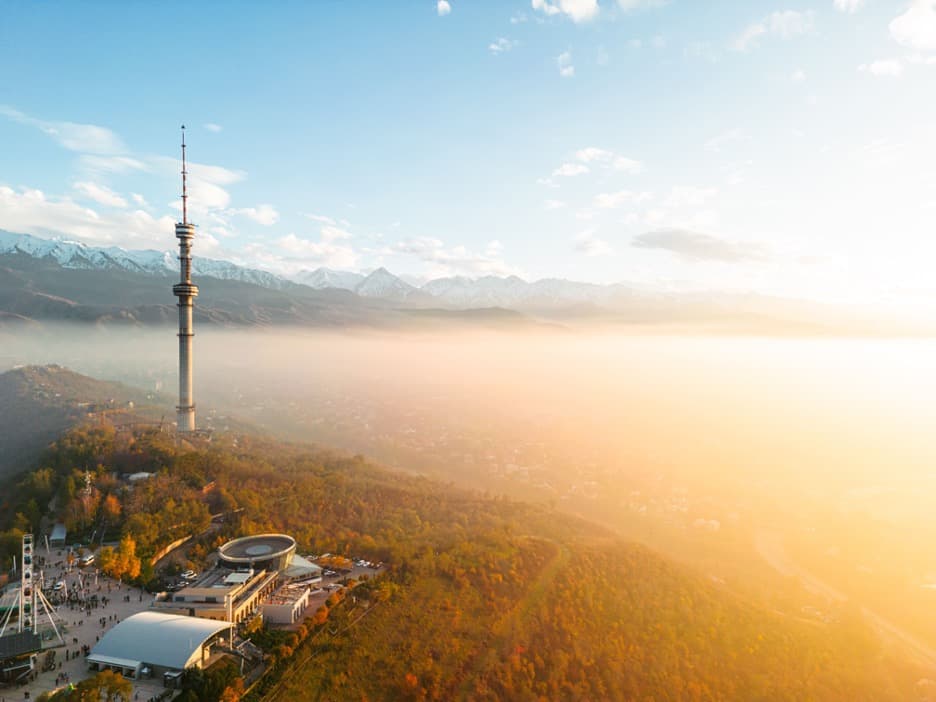
Panoramic viewpoints of the hills around Bishkek, Almaty, and Tashkent show dark bands of smog hanging at an altitude of about 1.5 to 2 kilometers (about 0.9 to 1.25 miles) even during summer when no coal heating is employed. In winter, emissions of harmful substances, such as sulfur dioxide SO2, nitrogen dioxide NO2, ammonium NH4, and methane CH4 in the atmosphere, increase as more fossil fuels, including coal, are burned for heating, and people are less likely to switch off their car engines.
According to statistics on volume of pollutant emissions in the atmosphere, Kazakhstan registered over 2.2 million tons of emissions released in 2024, while the volume of captured and neutralized pollutants was 2.27 thousand tons. The main obstacle is that Kazakhstan’s air emissions accounts (AEA) cover only certain pollutants and primarily stationary sources, but do not yet include greenhouse gas (GHG) emissions or all emissions related to transport. Uzbekistan’s industrial emissions were reported at 8.7 thousand tons in recent years, with additional significant emissions from transport (around 1.3 million tons annually) according to national environmental assessments. Tajikistan shows approximately 4.5 thousand tons of emissions per year since 2012 with an increase by 1.8 times over 10 years.
Suffocating Cities
Air pollution has also become one of the biggest challenges to urban transformation for Central Asian cities. Since the beginning of January, Bishkek in Kyrgyzstan, Almaty in Kazakhstan, and Tashkent in Uzbekistan have repeatedly appeared among the global top 10 for air pollution, according to the IQAir monitor. In November, Tashkent’s PM2.5 concentration reached 229, ranking as the third most air polluted city behind only Delhi and Lahore.
Central Asia’s geographical and meteorological characteristics magnify the problem. The weather conditions can turn chronic pollution into acute smog episodes. Winter across the region produces frequent temperature inversions where warmer air settles above colder air near the ground, effectively sealing pollutants in the lower atmosphere. As for the cities located in valleys or basins, like Almaty and Bishkek, vertical inversions and weak winds trap pollution so that it can’t rise. On the first, second, and third day of such weather patterns, the buildup can reach extreme levels which is when the region’s cities suddenly jump to the top of global pollution rankings.
Soviet architecture in Almaty (1960s–1980s) actively employed principles of natural ventilation to combat smog and heat, based on open-plan urban blocks designed for high air circulation and the creation of "green corridors" along streets and wide avenues. These designs facilitated the influx of mountain breezes. Residential areas of the city prioritized "breezy" courtyards oriented perpendicularly to facilitate airflow. This approach was further facilitated by the absence of unrestricted building practices during that era, which was abandoned with the advent of market-driven urban growth today.
Therefore, environmental concerns coincide to some extent with accelerated urban development plans. New skyscrapers along the foothills of the mountains disrupt long-established airflow patterns, while the rapid expansion of industry further compounds the problem. Last year Uzbekistan’s President Shavkat Mirziyoyev approved a decree designed to stabilize housing and mortgage sectors.
His plan envisions doubling annual housing construction by 2040 to 421,000 units. Such a highly ambitious goal concerns experts that it could exacerbate environmental challenges if not paired with sustainable development policies. When introduced abruptly and without integrated planning, increased industrial activity can reverse earlier environmental gains by intensifying air stagnation, trapping pollutants, and amplifying the urban heat island effect.
Dust and Sandstorms
Soil and desert dust make a larger contribution to PM2.5 levels in the region than in most other parts of the world, accounting for roughly 20–50% of total annual exposure. Sand and dust storms and transboundary pollution in general are among the most challenging types of air pollution, as they require international cooperation on research, early warning capacities, and finding the main sources of the storms. Meanwhile climate change increases the occurrence and intensity of extreme weather and contributes to desertification, which can also increase storm frequency.
Dust storms are quite common across the dry, windy landscapes of Central Asia. However, recent cases of storm hits are more often now seen as cataclysmic. One powerful storm brought winds of up to 70–90 km/h to Tashkent in 2021, generating a massive dust cloud that reduced visibility to 200 meters. Noted by NASA Earth Observatory, PM10 levels reached 18,000 µg/m³, which is around 30 times above safe limits, marking an unprecedented event in 150 years of observation. In Dushanbe, health authorities have already reported an increased influx in hospital admissions during dust-storm seasons, especially among children and the elderly.
In regions hit by dust storms, air and water pollution increases, as well as transportation becomes unreliable. These weather conditions can also damage crops, infrastructure, and machinery, leading to interruptions in essential services and supply chains.
Policy Measures to Highlight
If dust storms account for 20–50% of total annual exposure, the remaining 50–80% stem from human-made actions, which indicates that emissions can be reduced through targeted policy measures. Effective cooperation among countries in the region is therefore crucial, along with the development of shared information and data systems to improve air quality monitoring. The need for stronger coordination among agencies producing environmental data is highly important. Improving data accessibility is essential, including the creation of a structured database containing information with relevant territorial and social disaggregation over time, which would facilitate the analysis of inequalities and climate impacts.
There is also a strong need to develop technology for better air quality management. Many states in the region still lack advanced carbon capture equipment. At the same time, reducing reliance on traditional fossil fuels and shifting toward renewable energy sources could make a major difference in lowering emissions.
From lessons learned in the Soviet era, cities also need to be planned and maintained carefully, with green spaces designed thoughtfully with a genuine commitment to becoming smart, sustainable urban centers. Good transport policies are equally important, since vehicles are a major source of air pollution. Therefore, investing in public transport and managing traffic efficiently can all help improve air quality.